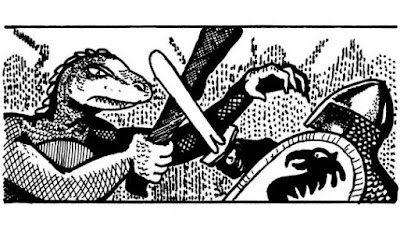
After finishing that "Knights in Orcus' Service" post and knocking around ideas for the other Chaos patrons in my setting, I realized I needed my own rules for demon weapons. Creating these items for my home game, I've been forced to cobble things together haphazardly. It's been rather annoying and nothing has felt quite right, so this is my attempt to streamline the rules for my home games - in whatever version of D&D I happen to be playing.
After using these rules several times in my home game, I feel good enough about them to post up. If I change them in the future I may come back and edit this.
First, let's examine the books I already have:
Realm of Chaos: Slaves to Darkness - The rules for Demon Weapons are cool as fuck, and clearly inspired by Elric. "Slays any unit it hits" is a bit much though. The magic effects from the Chaos Weapons section are good and the artwork is of course fantastic.
Awesome, but it will need some massaging to work within D&D. We will come back to it later.
The Metamorphica Revised - The 'Ficto-Technica' section has tables for magic items. The best table is the one on pg. 208, "Demon-Possessed Items":
This will come up later on.
Just get it, it's $10 for the revised pdf or get the classic version FREE!
AD&D DMG - Pages 166-168.
The standard to which all others are compared! Tables for personality and special goals are fantastic, but the whole system is pretty complicated and you have to flip back & forth. As usual, it could do with a bit of organizing.
I will be using the DMG as the baseline. From there I have attempted to streamline the mathematics and make things a little simpler while calibrating for my home setting.
*****
CREATING INTELLIGENT MAGIC ITEMS
0: Start
Per the DMG - we begin with an existing magic item. It could be a standard book item or one of the DM's own devising. This system was originally for magic swords but could be applied to anything: other weapons, wands, rings, armour or whatever.
From there, a simple 6-step process:
1: Roll for item INT
2: Roll for Alignment
3: Roll for Special Abilities
4: Roll for Special Purpose
5: Roll # of Languages Spoken, if applicable
6: Calculate EGO & Personality Strength
1: Intelligence and Capabilities (%)
We begin with the base tables from the DMG to see if it has intelligence and a mode of communication, and determine starting EGO rating:
01-50: No intelligence. Stop here.
51-75: No intelligence, but a strong alignment. Roll on Step 2 and then stop.
76-83: INT 12, EGO 1, semi-empathy
84-89: INT 13, EGO 2, empathy
90-94: INT 14, EGO 3, speech
95-97: INT 15, EGO 4, speech
98-99: INT 16, EGO 5, speech, read nonmagical languages/maps
00: INT 17, EGO 11, speech/telepathy, read magical writings
Or, if you are going to make an intelligent item anyway, use this chart expanded to the full percentage range to avoid a lot of rerolling:
01-31: INT 12, EGO 1, semi-empathy
32-56: INT 13, EGO 2, empathy
57-76: INT 14, EGO 3, speech
77-88: INT 15, EGO 4, speech
89-96: INT 16, EGO 5, speech, read nonmagical languages/maps
97-00: INT 17, EGO 11, speech/telepathy, read magical writings
EXAMPLE - I begin with a magical +2 sword. I have no particular plan for this item, so let's see what the dice give me on the top chart. Rolling for intelligence I got a 91, lucky! This sword has INT 14, EGO 3 and the power of speech.
2: Alignment (d20)
If you use simple law/chaos alignment like I do, just ignore the good/evil component of the result.
Remember that all cursed weapons are Neutral.
1-5: Lawful Good
6: Lawful Neutral
7: Lawful Evil
8-11: Neutral Good
12-15: True Neutral
16: Neutral Evil
17: Chaotic Good
18-19: Chaotic Neutral
20: Chaotic Evil
Simple alignment: if Chaotic, 30% chance of a demon item
AD&D alignment: if any Evil, 40% chance of a demon (or daemon or devil) item
Unintelligent but Aligned Items
Simple: Can be wielded or held by anyone, but activated & special abilities only work if alignment matches exactly. Plain +x items are reduced by one 'plus' for every step of alignment difference.
AD&D: Can be wielded by anyone, but activated & special abilities only work if all non-neutral elements of the item's alignment match the wielder's (a Lawful Neutral item can be used by anyone Lawful). This doesn't work in reverse - a Lawful Good item can only be used by Lawful Good characters. Plain +x items are reduced by one 'plus' for every step of alignment difference on either axis.
Intelligent Items
Simple: Handling an item of opposite alignment deals damage equal to item EGO. Handling an item one 'step' away (item or wielder is Neutral) deals 1/2 damage.
AD&D: All non-neutral elements of the item's alignment must match (as above), or handling the item deals damage equal to item EGO.
Demon Items
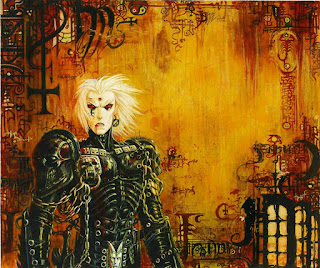
Can be used by characters of any ethos, all the better to corrupt them to the forces of darkness.
EXAMPLE - I use Simple alignment in my game. I rolled a 5, indicating the sword is Lawful.
3: Special Abilities
Roll for abilities based on item's INT:
INT 12: 1 detection ability
INT 13-14: 2 detection abilities
INT 15-16: 3 detection abilities
INT 17: 3 detection abilities, 1 extraordinary power Detection Ability (%) 01-08 - detect shifting rooms/walls/sloping passages 10'
09-16 - detect traps 10'
17-24 - detect undead 20'
25-30 - detect opposing alignments 10'
31-36 - detect similar alignments 10'
37-45 - detect precious metals, kind and amount 20'
46-54 - detect gems, kind and number 5' 55-66 - detect magic 10'
67-69 - detect illusions 10'
70-74 - detect secret doors 5'
75-80 - see invisible 10'
81-85 - locate object 120'
86-93 - roll twice, ignoring this result or higher (add 2 EGO)
94-00 - roll for extraordinary power (add 2 EGO)
Extraordinary Power (%)
01-06 - determine direction and depth, 1d2/day
07-14 - enlarge/reduce on wielder, 1d2/day
15-21 - spider climb for 1 turn, 1d3/day
22-28 - clairaudience for 1 round, 30' range 1d3/day
29-35 - clairvoyance for 1 round, 30' range 1d3/day
36-40 - ESP for 1 round, 30' range 1d3/day
41-46 - charm person on hit, 1d3/day
47-50 - knock, 1/day
51-56 - strength on wielder, 1/day
57-61 - invisibility to item's enemies for 1 turn, 1d2/day
62-66 - levitation for 1 turn, 1d3/day
67-70 - fly, 1 hour/day (add 1d3 EGO)
71-75 - illusion as the wand, 120' range 1d2/day (add 1d3 EGO)
76-80 - x-ray vision for 1 turn, 40' range 1d2/day (add 1d4 EGO)
81-86 - telekinesis for 1 round, 1d2/day (add 1d3 EGO)
87-90 - telepathy, 60' range 1d2/day (add 1d4 EGO)
91-94 - teleport, 1/day (add 1d4+1 EGO)
95-97 - heal, 1/day (add 1d4+1 EGO)
98-00 - Roll twice, ignore this result again (add 2 EGO)
EXAMPLE - INT 14 gives 2 rolls on the Detection Table. I rolled 03 - "detect shifting walls/rooms/sloping passages," and 71 - "detect secret doors." Not bad!
4: Special Purpose of Intelligent Item (d%)
Every intelligent item should have a special purpose.
All these goals are filtered by alignment. A lawful sword that must 'defeat or slay' will only select chaotic enemies of its chosen category, etc.
31-37: fighters 38-44: thieves 45-55: all non-human monsters 56-63: particular creature type (humanoids, undead, demons, etc) 64-71: particular race or kind of creature (elves, orcs, ghouls, etc) 72-78: servants of a specific deity 79-85: everyone!!
86-92: defend a particular race or kind of creature
93-00: defend interests of a specific deity
Intelligent items generally prefer to use their powers in pursuit of their special purpose, but will do so for general tasks as long as they are kept happy. Using the item in opposition to its special purpose (aiding those the item wishes to destroy, etc) provokes an immediate personality conflict.
EXAMPLE - Rolling for Special Purpose, I get a 75 - "defeat or slay servants of a specific deity." Since the sword is Lawful, I decide to randomly select from the Chaotic powers in my setting. I end up with INMA, EMPRESS OF THE WORLD, a petty god worshipped by degenerated elves.
5: Languages Spoken
It's assumed the item can understand its wielder in any case. This determines the number of languages the item can speak aloud, if it is able. Per the DMG:
# of languages (%)
01-40: One
41-70: Two
71-85: Three (+1 EGO)
86-95: Four (+1 EGO)
96-99: Five (+2 EGO)
00: Six (+2 EGO)
What Language? (%)
Here is a chart from my game as an example.
01-15 - Imperial (aka Common Viridian)
15-20 - Alryan
21-25 - Antillian
26-30 - Dunael
31-35 - Ghinoran
36-40 - Skandik
41-45 - Tharbrian
46-50 - Amazon
51-55 - Altanian
56-60 - Avalonian
61-65 - Orichalan
66-70 - Old High Viridian
71-72 - Wild Speech
73-74 - Skeletongue
75-76 - Duvan'Ku
77-87 - Grimscribe
88-91 - Demonic
92-93 - Wild Elf/Bog Elf
94-95 - Lizardfolk
96-99 - Chthonic Elf
00 - Something really old/rare (draconic or something else cool)
EXAMPLE - Here I rolled fairly low, a 15. The sword can speak one language. I rolled Wild Elvish and decided it was made by the elves to destroy the heretical cult of Inma!
6. EGO Modifiers & Personality Strength
1 - Begin with item's starting EGO score as per Step 1.
2 - Add 1 EGO for every magical 'plus' an item has. Double this bonus for weapons that came into the process with special abilities (a +1 sword adds +1 EGO, a +3 sword of sharpness adds +6 EGO, etc)
If the item is some weird thing from an OSR blog with no pluses you must use your discretion. Eyeball a power level between 1 (+1 sword, simple misc. magic item) and 10 (+5 holy avenger, staff of the magi). If you're completely stuck roll 1d10, or 1d6+1d4, or whatever.
3 - Include bonuses from Step 3 and Step 5, if any.
4 - Add the item's INT + EGO together to find its Personality Strength (PS).
EXAMPLE - The sword started with EGO 4. Add 2 for the sword's +2 bonus.
Total EGO of 6.
"Xyrxidon" Sword +2, Lawful
INT 14, EGO 6, speaks wild elvish
Detect shifting rooms/walls/sloping passages in 10' , detect secret doors in 5'
Resolving Personality Conflicts
Personality conflicts arise when the intelligent item's desires are not being met by its wielder. These contests are resolved with Personality Strength scores.
The wielder of an item has Personality Strength equal to their INT + CHA + level. This diminishes as the character suffers damage. The experience level component of this formula is reduced in proportion to hit point damage suffered.
The DMG explains it quite Gygaxianly, it's actually less math than it seems. The DM needs to calculate this just once (and when the character gains a level). Find the character's hp breakpoint at which the item's PS is higher than his, and make a note of it. There is no need to keep track of floating modifiers, since they don't matter most of the time.
EXAMPLE - Tjarg the Fighter is 5th level with 9 INT, 9 CHA and 30 hp. He normally has a Personality Strength of 5+9+9 = 23. For every 1/5 of his total hp he loses (6 points in this case) he deducts 1 point from his PS - so at 24 hp his PS is reduced to 22, at 18 hp it is 21 and so on.
If Tjarg is using our +2 sword above with its INT 14 & EGO 6 (PS of 20), you can see clearly at 12 hp he is tied with the sword and once his hp reaches 6, the sword's personality is stronger than his! All Tjarg's DM needs to do is write down "Tjarg loses contest w/sword at 6 hp."
As long as the item has a lower Personality Strength than its wielder, it can make its desires known and refuse to use its abilities if frustrated, but has no power over the character.
When an intelligent item has a PS higher than its wielder it may dominate him at any time. It may force him to attack certain opponents or allies, refuse to strike foes, force him to surrender or to drop it, etc. The likelihood of this happening depends on the relationship between item and wielder. It may make other additional demands - encrustation with gems, a fancy scabbard or case to be stored in, other efforts toward favoured causes, things like that.
Optional Rule for Personality Conflicts:
One thing I don't like about the DMG rules: it is trivial to roll up an intelligent weapon that will never win a personality conflict! This doesn't seem that exciting to me. Maybe you want a bit more uncertainty in your game?
It requires a bit more note-taking. The DM must note the wielder's Personality Strength at multiple breakpoints. Perhaps full hp, slightly hurt, half hp and near death. Keep these notes nearby for reference. When a personality conflict arises, the DM rolls 1d8 for both the item and wielder, adding it to their PS scores before resolving the contest.
EXAMPLE - A magical boon has increased Tjarg's INT and CHA scores to 10. His Personality Score is now 25. His humble sword can only win a battle of wills when he has 0 hp left - not very useful! Instead, the DM notes his Personality Strength at 12 hit points (PS 22) and 6 (PS 21).
During a difficult fight Tjarg gets hurt badly, reducing his hp to 11 (therefore, PS to 22). His sword has new plans for him and attempts to take control. The DM rolls 1d8 for each of them. Tjarg gets a 3, totaling 25. The sword rolls an 8, totaling 28. Today isn't Tjarg's lucky day...
I have not tested this idea very much. It would have to be calibrated. You could make it more or less random by changing the size of the die. If you used a d4 or d6, upset results would be rare. A d20 would make the whole thing way too random. d8 or d10 seems like a nice middle ground - the die roll will count for about 1/4 to 1/3 of success or failure, with the remainder upheld by statistics. Just enough that one can't be certain all the time!
Optional Rule for Different Versions of the Game:
The DMG rules are calibrated for players with certain statistics. Probably using 4d6 drop-the-lowest method, or perhaps something more generous than that. From the anecdotal evidence I've seen, successful AD&D PCs tend to have 1, 2 or even 3 exceptional statistics (15 or over), with the rest hovering around average. Consider this when calibrating the PS of your intelligent items.
If you play B/X and use 3d6 in order, for example, maybe you would reduce all item PS scores by 10-20% to balance out the lower stats.
[CHANGES]
This system will generate intelligent items that are slightly different from the DMG version in some ways:
Section 1 - Ignore "no intelligence, but strongly aligned" and this is exactly as per the DMG, I just condensed the math for you.
Aligned items being commonplace adds a sense that they were created for a real purpose. Picking up a wand of fireballs that only works for Chaotics, an Evil sword of sharpness, or a suit of armour made by a Lawful cleric helps to embed these items in the game world.
Section 2 - I rearranged the order of the alignments so that law, neutrality and chaos were grouped together, but the chances of rolling a given alignment are still the same. Effects of opposing alignments are standard for AD&D 2-axis system, and extrapolated from there for simple alignment. [EDIT - I had to fix this. Before damage was impossible if the wielder was Neutral, lame]
Effects of aligned, but unintelligent weapons are my own.
Demon weapons will occur about 6% of the time, and be explained in a later post.
Section 3 - The first table is BTB.
Extraordinary Powers are more likely (7% instead of 2% BTB), but the really powerful ones will occur less often so this seems fair. Some of the better Extraordinary Powers now add extra EGO to the item. This is fair, since rolling up an item that lets you teleport or fly every day seems like a really big deal!
I reworked the abilities so they fit my game better and have more variety. Sloping passages and trick walls are rare in my dungeons (unlike in the old days) so I combined them into one result, then I added some other cool abilities, etc.
Section 4 - Basically the same but I added more purposes to the table to give it some variety.
I removed "special purpose powers," so you'll never get a disintegrate-on-hit sword, but those were only going to happen 0.02% of the time anyway, so who cares?
Section 5 - BTB, I just included the EGO modifiers to make your life easier.
Section 6 - BTB, I just helped with the math.
*****
This is already getting long, and even more tables are coming up so let's quit while we're ahead. Rules for Demon Weapons coming up in the next installment!
My Land's End II campaign uses Melan's Sword & Magic rules, which are great. I have fiddled with this stuff enough that it seems worth posting about how it's going. We'll start with the playable character races in the setting.
Everything here is written to be player-facing, except what's behind the DM Notes.
HUMANS
Skin colours may vary, but no mechanical differences.
No level limits +1 extra skill at start
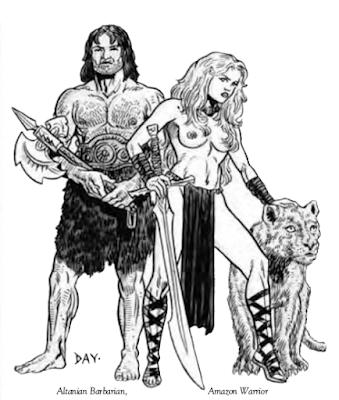
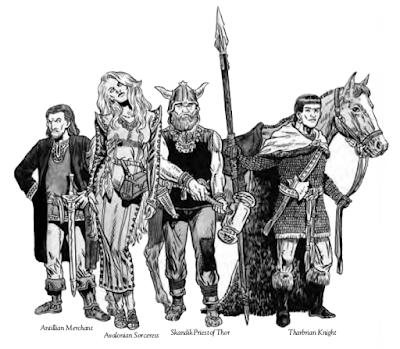
DM Note: Land's End is in the Wilderlands, so the usual suspects are around: Orichalans, Tharbrians, Viridians, Altanians, all the wonderful primary-coloured folks! The PCs in this game have no idea of their origins because they all started as slaves to the lizardfolk. I rolled randomly for their human subtypes, but if the campaign started differently I would have given them a list to pick from.
WILDMEN
Degenerated humans, or perhaps their distant forebears? It is unclear. Crude features, slightly hunched posture.
+1 STR, +1 CON, -1 INT, -1 WIS Level limits: Fighter *, Cleric 5, Thief 5, MU 0 Begin the game illiterate.
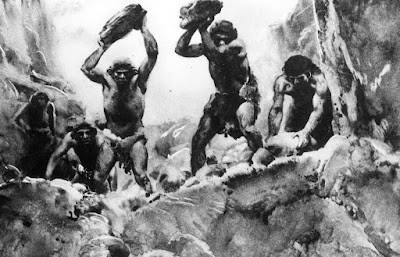
DM Note: The wildmen's exact nature is left vague intentionally. They are a broad category that might be "primitive hunter-gatherers" as easily as degenerated or mutated men, or Neanderthals. They can pass as normal humans some of the time. Since I use cavemen where orcs would normally go, we can call wildmen the half-orc equivalent of Land's End.
HALF-ELVES
Savage tribesmen scratching out a living on the edges of civilization. Their mixed blood has driven them to strange practises.
Get the Find Tracks skill for free, and treat Read Signs as a class skill.
Can use bows even if their class is normally unable to. Level Limits: Fighter 9, Cleric 5, Thief 9, MU 9
ELVES
The doomed race. Once they ruled the world, now they are dwindling, rare & lost in the wilds.
+1 DEX, -1 CON
Treat Read Signs as a class skill.
Can use bows even if their class is normally unable to.
Immune to Sleep and +2 to save vs. Charm.
cannot be raised from the dead by ordinary magic
Level limits: Fighter 9, Cleric 7, Thief 6, MU 9
DM Note: I have tweaked these bonuses slightly to fit into the setting. Pure-blooded elves are hard to find, half-elves are commonplace. They usually live in the wilderness, barely scraping by, living off nomadic herding and raiding human settlements. Elves don't look super-elfy in Land's End - pointed ears, maybe a smaller build than the average human, slightly odd features (like a human with a bit of prosthetics and makeup, not like the anime-elves you see sometimes). Half-elves might be anywhere in between, and can often pass as human.
CHTHONIC ELVES
Spending their lives underground or in dark jungles has made them strange. Rumours of cannibalism & demonology keep most other races away from the ruined cities they infest.
+1 STR, -1 CON, -1 CHA
Darkvision - With no other lights, can see in the dark in a limited way. Black & white, very little detail.
Light Sensitivity - During the day, -1 penalty on perception/initiative/attack rolls due to squinting. -2 on bright sunny days.
Ghoulish - Once per day, consume the flesh & blood of a recently killed humanoid foe to gain back 1 hp/level, up to the maximum of your hit die (ie. M-Us max out at 4 hp this way, Fighters at 10).
Level limits: Fighter 9, Cleric 9, Thief 7, MU 6
Usually, less armour is worn.
DM Note: I don't remember where I got the idea for these guys, but I have seen similar things in the OSR here and there. Someone else probably deserves the credit. Nevertheless I think they are cool so they are here to stay!
LIZARDFOLK
Fearless hunters with their own sense of honour and tradition. Usually they find "warmbloods" difficult to deal with, preferring to keep to themselves. They follow no gods, instead seeking harmony with the natural world.
Natural bite attack (1d4+STR bonus). Can use in a grapple, or in addition to regular melee attacks with -5 to hit. Natural armour (+2 AC - cumulative with light or medium, but not heavy armour) +1 STR, -1 INT Level limits: Fighter 9, Cleric 3, Thief 5, MU 3 One of their starting skills must be swimming.
DM Note: Simplified versions of 3.x edition lizardfolk. Extra attack & natural armour are balanced by fairly harsh level limits and reducing the skill selection a bit. Also interspecies tensions may arise. They are my favourite humanoids and I like using them everywhere, especially since Land's End is a tropical climate, mostly jungle and swampland.
PLANETOUCHED
One-in-a-million freaks of nature? Children of demons? Nobody knows. Each is infused with otherworldly forces. Their features are "angelic," "demonic" or partake of one of the four elements. (An "air" planetouched might have hair that constantly moves in an unseen breeze, an "earth" might have coal-black skin or gemlike fingernails). Rude people call them "Demonbrood."
Each planetouched has +1 to one attribute and -1 to another, and level limits ranging from 3 to 9. Otherworldly nature, attribute bonuses, level limits and appearance are all generated RANDOMLY by the DM!
Inspired by, but not exactly like this.
DM Note: Some may call into question my old-school credentials for allowing Tieflings, Aasimar, and whatever the elemental ones are called. In my defense, I make all the rolls behind the DM screen. This eliminates the asinine "build" aspect of character creation - picking Air so you can get +1 INT in order to play an M-U, or whatever. This is for advanced players who want to try something new and don't mind letting the dice fall where they may!
Putting all these types in one category also reinforces the in-game ignorance and fear that would attend them - is that guy with red horns touched by Infernal forces, or is he just a fire-guy? Nobody knows, and why take the chance? Tar & feather him!!
There are no rerolls allowed! If the player doesn't want to play the character that's been rolled up, that's fine - but the DM should note all rolls made, just in case. Some of the special abilities are powerful, but I feel it's fair since there is no way of knowing what you'll get. The DM might also want to limit these characters to 1 per group or something since they are so rare, but it depends on your milieu.
The descriptions of the elemental-kin are a list to pick from. Not every single one looks exactly the same. Most of the following is from the 2nd edition Planeswalker's Handbook, or the Pathfinder SRD. I've just streamlined and adapted it for the system.
Air Attributes: light blue skin/hair, sometimes with swirling markings; surrounded by constant breeze; distinctive breathy voice, strange inflections; flesh is cool to the touch.
+1 on saves vs. air magic, additional +1 at 9th
Can go without breathing for 10 mins/day/level
Earth Attributes: brown, black, grey or white skin & hair; metallic sheen to skin; hair like crystalline spikes; blocky features, thick torsos & limbs; rough, gritty flesh; deep, slow, rumbling speech; eyes like deep black pits or sparkling gems.
+1 to saves vs. earth magic, additional +1 at 9th
Natural Armour +2 AC (stacks with everything)
Natural understanding of stonework
Climb skill for free
Fire Attributes: deep red, coal-black or brassy skin; scales of charcoal; red or mottled horns; deep red hair moving like waving flames; voice crackling like a fire; perpetually warm or hot flesh; fiery red eyes.
+1 to saves vs. fire magic, additional +1 at 9th
60’ infravision
Water Attributes: blue-green skin or hair; blue-black eyes; light layer of scales; fin-like ears; webbed hands or feet; hair waving and swaying as if underwater; muffled voice resembling underwater sounds; cold, clammy flesh.
+1 to saves vs. water magic, additional +1 at 9th Breathe underwater 30 mins/day/level Swim skill for free
Celestial / Infernal Appearance: (%) Roll twice.
Results before the slash are for Celestial-blooded, results after for Infernals.
01-04 – swirling patterns on forehead / horns on forehead 05-06 – unicorn horn / horns on temples 07 – halo floats above head / single horn on forehead 08-09 – long, thin face 10 – metallic lips / fangs 11 – pearlescent teeth / pointed teeth 12 – musical voice / forked tongue 13-14 – pointed ears 15 – catlike ears / webbed fanlike ears 16 – long nose 17 – tiny or nonexistent nose 18 – long eyelashes 19-21 – amber eyes / red eyes 22-23 – white eyes / black eyes 24 – feline eyes 25-26 – glittering eyes / deep-set eyes 27-28 – neon hair / murky, slimy hair 29-30 – metallic hair / animated hair 31 – multicoloured hair 32-33 – six digits 34-35 – burned-looking knuckles / extra thumbs 36-37 – fingers leave contrails / black fingernails 38-39 – glowing palms / red glowing fingernails 40-41 – fingers 1” longer than normal 42 – arms 6” longer than normal 43 – legs 6” longer than normal 44-46 – birdlike legs / horse legs 47-49 – feline legs / goat legs 50-52 – small feet / goat hooves 53-55 – androgynous 56-57 – fox tail / aquatic tail 58-59 – tiger tail / lizard tail 60-62 – lion’s mane / spiny ridge on back 63-65 – vestigial wings / spiny ridges all over body 66-68 – totally hairless 69-71 – body covered in short fur 72-73 – body covered in striped markings 74-75 – glittering skin / greasy skin 76-80 – scaly skin 81-83 – metallic skin / leathery skin 84-85 – feathers instead of hair on d100% of body 86 – prismatic skin / greyish skin 87 – sparkling skin / translucent skin 88-89 – special side effects 90-94 – roll twice 95-00 – roll three times
Celestial/Infernal Special Abilities (%): Roll once.
01-15 – roll on Appearance table
16-25 – roll on Special Side Effects table 26-40 – random 0th level spell 2/day 41-51 – random 1st level spell 1/day 52-55 – 1/2 dmg from fire 56-59 – 1/2 dmg from cold 60-63 – 1/2 dmg from electricity 64-67 – 1/2 dmg from acid 68-71 – darkvision 60’ 72-75 – infravision 30’ 76-79 – +1 to saves vs. fire 80-83 – +1 to saves vs. electricity 84-87 – +1 to saves vs. poison 88-91 – +1 to saves vs. cold 92-95 – +1 to saves vs. acid 96 – +1 to Fort saves 97 – +1 to Reflex saves 98 – +1 to Will saves 99 – roll twice 00 – roll three times
Special Side Effects (%): Roll as directed.
01-10 – no odour / ashy odour 11-15 – outdoorsy odour / sulfurous odour 16-20 – perfumed odour / rotting odour 21-25 – skin glows / skin exudes ashy grit 26-30 – winged shadow / casts no shadow 31-33 – clothing billows in invisible winds / no reflection in mirror 34-40 – susceptible to anti-outsider spells (protection from evil/good, cacofiend, dispel evil, etc) 41-50 – outsiders of opposite type react as though you are an enemy 51-60 – causes unease in animals 61-65 – causes unease in humanoids, reaction rolls -1 66-70 – touch causes plants to grow / wither 71-75 – claws or talons (natural attack for 1d3) 76-80 – high heat, touch inflicts 1 dmg 81-85 – cold, touch inflicts 1 dmg 86-90 – strange skin, base AC 8+1d6 91 – cannot reproduce 92 – unholy/holy water deals 1d6 dmg 93 – can be turned by clerics of evil/good 94 – cannot enter unholy/holy areas 95 – gains DR 5/silver or magic 96-00 – speak/understand a random ancient language
There you have it, my foul origins in the '90s hellscape of 2nd edition are revealed. Oh whale! Folks may also wonder at my rearranging of the attribute bonuses, but those with eyes to see & ears to hear may notice what scheme I am working from.
*****
Classes in Land's End
The core of Sword & Magic is the same 4 classes we know and love.
The fighter has 5 subclasses (plain fighter, sailor, archer, barbarian & amazon) each with a few minor special abilities. I called the sailor class 'hunter' because it fits the jungle theme of the campaign, at least for beginning characters. Magic-users are subdivided into regular M-Us and illusionists. While illusions are tough to adjudicate sometimes (I am halfway through that insane 40-page article on Phantasmal Force from Footprints #25), the class has style, flavour and lineage, therefore it must stay. Clerics and thieves are good just how they are with sneak attacks, turn undead, etc. all working like we're used to.
I couldn't help noticing the lack of bards, assassins, druids, monks, paladins or rangers though! I decided that paladins and rangers probably wouldn't fit the jungle-survival-horror setting. Assassins are great but with a comprehensive skill system they are not mechanically different from the existing thief. Bards? Not interested.
Druids do belong in the setting since so much of Land's End is about struggling through dangerous natural landscapes. I had a place for monks, too, in the hidden shrines and monasteries that would dot the region - I was already thinking of unique monk techniques from different schools, that sounded like fun. I thought it would be a fun challenge to elevate the class from the usual "dudes from fantasy-Asia get parachuted into ren-faire England" thing.
At this point I looked back to Pathfinder. While I hate the system, some of the character classes are really good. Was the witch worth keeping? (maybe... I have yet to see a good witch class in any edition) How about the alchemist, psion or occultist? (nah) Sorcerer? (HELL to the no) The oracle? (definitely!!)
This gave me an expanded class list rooted in the classics with a sprinkle of the new:
I haven't been blogging as much of late because I've spent all my time prepping for our online q-teen game in the City-State of the World Emperor. I have a big pool of players and it's a lot of fun, but we are playing more frequently than I'm used to! As the game develops I'll eventually have a backlog of material that I can share, but for now I am focusing on the most immediately useful stuff.
Here's a post I've been thinking about for a while, as I look to the future of the Land's End game:
This modification to the core of 3.x/d20 is the only way I will consent to playing damned Mathfinder. It allows me to chop, flog and edit the system to my heart's content without fretting overly about the rules not working consistently across all 20 levels. If it works with normal humans and 1st level characters, a modification will probably be fine at level 6.
The party just reached level four, and I have to start thinking about how to handle the PCs reaching level 6. More feats will be necessary, obviously. But I think the fun of E6 will be attempting epic-level stuff. Killing legendary monsters, stealing the golden fleece, things that heroes of legends do. When all you get is one fireball, you'd better make it count. How else can the players make the best use of their power in the game world?
First of all, the core tenets of E6 won't change:
Six Hit Dice
It doesn't matter how many cool abilities you have - falling off a cliff, being swallowed whole by a dragon or chopped up by a motivated mob of lowly orcs are all deadly. That doesn't mean you can't take feats like Toughness to get more hit points, of course.
BAB +6
Feats could give situational bonuses and modifiers, or allow fighters to chain up to feats that require a higher BAB. But the whole idea is that the best swordsmen in the world are only a certain degree above a normal human.
Look at it this way: a 0-level peasant with a +5 sword (a godlike weapon, impossible for normal humans to make) is almost even with a 6th-level master armed with his old campaigning sword. I love that symmetry.
No Generalized Power Increases
Bonuses after 6th should improve specific aspects of the character, not upgrade their overall power level. Anything that increases a character's power across multiple dimensions (like lycanthropy increasing hit points, attack bonus, armour class, etc) should come with stiff drawbacks or be only situationally useful.
Extraordinary Results Require Extraordinary Effort
Not a core tenet of E6, but it flows from what I'm thinking about. Taking your allotted feats after sixth level is the natural order of things. Spending a feat or two to take abilities from a prestige class or something takes extra XP, but no extra work.
PCs who want to go above and beyond need to go on quests, consult sages, spend money, peruse forgotten tomes, take risks, utilize lost treasures, risk sanity loss, etc. in addition to gaining the required XP. All the good player-directed adventuring sandbox stuff that I try to encourage!
A Dangerous World
It should be obvious, but things ramp up at this level. Not as dangerous as your standard level 1-20 world - after all, part of the E6 magic is that the ecology of the game world can be at least a bit fucking comprehensible. The world nevertheless needs dreadful monsters that can't be defeated readily in a straight-up fight. Why bother opening up the Necronomicon and risking mutation & madness on the off-chance your wizard can make all his rolls and learn Finger of Death - unless you really need it to kill the dreaded Sludge Dragon of the Drowned Lands and your solitary 3rd-level spell won't cut it?
Players that reach 6th and become "epic level" might think they have no need to take risks. Epic 6 should be more like finishing an apprenticeship: a license to take on bigger challenges, and a sign that your initial 'adventurer puberty' of rapid learning and growth is over. Development now takes hard work.
Epic Problems require Epic Solutions.
E6 POWER-UP METHODS
Finding The Weird Stuff
The most basic option. The epic-level dungeons in Land's End are plentiful: the Tomb of Abysthor, catacombs beneath the lost city, serpent-men ruins, other dimensions, crashed alien... well, I've said too much already. All of these ultra-dangerous dungeons are crammed with as much cool shit as I can fit, and none of it is available anywhere else in the setting. Balancing that out are brutal traps and hordes of tough foes. Most of these locales are optional, extremely hard to find/get into, or both.
Magic Item Creation
A classic of high-level play. In E6, level limits on feats still apply. Based on the feat requirements in the PF core rulebook, 6th-level casters can create scrolls, potions, wondrous items, wands, magic arms & armour. Rods, staves & rings are beyond mortal abilities completely (LotR anyone?).
Of course some items in each of these categories are beyond a 6th-level caster anyway. A +2 enhancement bonus and a handful of special properties (distance, merciful & thundering) are all the magic weapons a 6th-level enchanter can create. This is perfect for me - even aligned weapons (axiomatic, etc) are beyond the PCs' ability, as they're products of extraplanar energies.
If the PCs want even better magical gear, they need to pick up the various lost relics & demon-haunted weapons throughout the landscape, grappling with their personalities, properties & curses.
Of course the long & more fun way is available also. Through mighty deeds, the players may create weapons normally impossible for mortal 6th-level heroes, and these weapons will hopefully pass on into song & story after their adventuring careers are over, where a more straightforward sword +2 created by choosing a feat and spending money (yawn....) will not.
Covenants
You all know how much I love Dark Souls and Warhammer!
Entering into a pact with one of the ruinous powers usually helps out. For a while, anyway. None of the PCs are Lawful, so it seems pointless to even detail the benefits those entities would grant. Instead, I'll work up more chaos patron tables for Abraxas, Tsathoggua, Jubilex, maybe a few others as the setting demands. If the PCs want to sign on with the forces of darkness, that's fine with me (they aren't too far off as of now).
Meanwhile, some ancient beings survive from the times before mankind. If they could be bargained with, perhaps their secrets can be learned (this is a subset of Finding the Weird Stuff). For example, the sorcerous giant Nibolcus (see The Man From Before) knows magics long lost to the world. At what price would he take on a new student?
Mutations
I mentioned a giant mutation chart in an old post a while back. Very difficult to control, but maybe a "potion of beneficial mutation" (or an updated version) could be found or created that would limit the number of really harsh effects. Probably too risky for the fearful players in my game, but might come up as a desperate gambit or side-effect of something else. The Metamorphica will come in handy here.
Night Hag
Wouldn't give your witchy PC more levels, but upgrades your Hit Dice and give you more spells at the cost of stat & alignment change, some new vulnerabilities, being cast out of polite society and having to help your coven with various tasks. The process for this will be similar to lichdom - an esoteric ritual known only to few. There is a witch in the swamp attempting this right now, maybe she can be persuaded to give up her secrets? (also see Witchy Wednesday)
Lycanthropy
Easy to contract, hard to get rid of. We know the rules. The dread forvalaka roams the wilderness, so the changing disease could be contracted during the normal course of the game if the PCs aren't careful. The weakest form of transformation probably. It's hard to control and comes with serious drawbacks (I'll be using that chart in the AD&D DMG) but it could be narrowly useful for a fighter or barbarian who needs an edge from time to time.
Vampirism
So far there is one vampire in the setting, a hold-over from a bygone age. Trapped in a lead coffin, it has been waiting for centuries, hopelessly mad. Letting it out is probably a big mistake... but in a land covered in perpetual clouds, being a vampire might not be so bad? Increased stats, undead immunities and some great special abilities make this transformation a great move in a setting with very few high-level clerics. This option is open to PCs, but then we'll have to mess with templates and it will be a real fiddle-fuck. And of course the trapped vampire might just kill them all.
Lichdom
There are a few liches in the region. Mostly they are happy to kill anyone they see, but one of them can be negotiated with. Prying his secrets will be a serious challenge but it could happen. Certainly this would lead to some great immunities, better hit dice and perhaps some more spell slots - I'll have to give it some thought, and dig up PF's stupid rules for templates.
Other Undead
Servants of Orcus (see link above) might be turned into skeletons, zombies or ghouls up to 6th level, or perhaps wights if they have a great deal of experience beyond 6th. There are other undead in the wilderness that might strike the players and transform them - shadows, ghosts, etc. Still, this is more of a fail state than anything the players will likely aspire to. If they do get transformed, I will offer them the option of continuing play as an undead character with all the relevant drawbacks or relegating the unfortunate to NPC status (possibly a new villain).
Brainstormer/Fuse Meister
Sort of like special cases of lichdom. These two are much more difficult to make work as PCs, and perhaps I'll leave as antagonists, unless someone is really that crazy!
"Ivory Tablets: One of the many long term sub-sub-subplots of the campaign. My attempt to fix the stupid Deck of Many Things into a powerful divination tool & force to rewrite one's destiny. Created by the high elves 5000 years ago. The individual "cards" must be assembled and brought to the shrine of Divine Providence deep beneath the Lost City where the Chthonic Elves dwell. I haven't decided what each card does yet, but I really dug myself in deep with this one. All the major arcana and 4 cards from each suit, for a total of 38!"
Well, luckily Mithril & Mages pointed me in the right direction. Dragon Magazine #77 has rules for an expanded Deck of Many Things based on all the tarot cards. Awesome! The powers aren't annoying things like "dead" or "gain 100,000 xp," rather stat changes (I'll rule that this can increase above normal maximums), strange events in one's life, saving throw modifiers, gaining tremendous wealth or losing all your money, getting pranked by magical creatures, etc. Very cool stuff and if the PCs ever assemble the deck (a tall order indeed, considering where a few of the cards are kept!) they can try their luck with it.
*****
[EDIT: I forgot about the cards! Getting back into a setting you haven't looked at in a few months can take a bit of work...]
As you can see there are plenty of options for the power-hungry player character. Whether they take any of these, well... that remains to be seen. My next move is to seed clues, hints & fragments pointing towards these options throughout the world. Off I go to do that, and write up some more big dungeons. Excelsior!
Remember when I reviewed the mathematics for my random encounter tables? Today I have been thinking about the humble reaction roll. I use these and the morale rules (taken straight from Labyrinth Lord) in every game I run. I transplanted them into my Mathfinder game and they work fantastically. These days I would at a minimum hesitate to run a game without these kinds of rules.
So here are a few things I like to do to mess with reaction rolls. Some I've been doing for a while, but I was inspired to post about them when I remembered a conversation on d4 caltrops quite a while back. Ktrey really ran with the idea of overloading various rolls to create more information about a monster! This breakdown is a bit simpler but these techniques work well for me, and hopefully the reader may find them useful.
By The Numbers
Note: I've inverted the normal "lower is better" reaction roll for ease of use, so +1 is an improvement and -1 is a penalty. No need to confuse things.
Normal PF stat modifiers are +1/-1 for every 2 points away from 10. Obviously I use the stat modifiers from Labyrinth Lord to match the reaction rules. This is funny because my players ask "What does my 'Reaction Skill' mean? Why is the bonus so low? Why can't I put points into it?" I have to explain it all every time.
LL's CHA modifier table looks like this:
3: -2
4-8: -1
9-12: +0
13-17: +1
18: +2
Not much of a bonus, but on a 2d6 roll it really changes the game. Jeff talks about this here. Even a 13 CHA makes "instant hostility" impossible, and that 18-CHA paladin makes friends with a monster on 10, 11 or 12! As always with classic D&D, the rules support each other if you use them all together: rolling stats straight down the line means having a character with the gift of gab is a lucky situation not to be overlooked.
Circumstance Modifiers
The basic thing I do to mess around with reaction rolls is a flat modifier based on the temperament of the creature, or circumstances in the dungeon or wilderness region. A few examples from my Land's End random encounter tables:
Lizardmen: Neutral, standoffish. Jungle Bear: +2 to reaction. Rarely hostile unless provoked or near food/cubs. Goblins: -1 to reaction. Jumpy and irritable from being cooped up inside the fort. Mosquito Swarm: Thirsty!
Three basic possibilities: roll unmodified, roll with a bonus/penalty, or instant attack. These modifiers could be likened to a 'slide' of the probability curve up or down. Note how they can drastically change results at the extremes, so keep that in mind.
Reaction Rolls based on Modifiers (%):
Modifier
Hostile
Unfriendly
Neutral
Indifferent
Friendly
-4
41.7
41.7
16.7
0
0
-3
27.8
44
25
2.8
0
-2
16.7
41.7
33.3
8.3
0
-1
8.3
33.3
41.7
16.7
0
0
2.8
25
44
25
2.8
+1
0
16.7
41.7
33.3
8.3
+2
0
8.3
33.3
41.7
16.7
+3
0
2.8
25
44
27.8
+4
0
0
16.7
41.7
41.7
Going beyond +/-2 obviously can only happen by combining extreme CHA scores and situational modifiers. I include them for completeness and info-tainment purposes. Be careful when that 18 CHA PC starts taking the lead!
Limits
Another possibility. Less extreme than +/- modifiers, more consistent results. Simply determine the best or worst possible reaction the creature might respond with. I would use this only in specific cases, as I think it's more fun to have a wide range of possibilities. For example:
Charau-Ka: Demon-worshipping ape-men. Disdain other humanoids, especially hairless ones. Best reaction is Neutral.
An encounter with the Charau-Ka has the same chance of being instantly hostile and a huge chance of being neutral (6-12). That charismatic paladin won't make friends with them, but has some chance of being able to defuse the situation without violence. This sets a limit to how well (or poorly) the encounter will go, while leaving some room for chance and stat modifiers to play their part. In a sense it is a halfway point between "instantly hostile" and a numerical modifier.
Quantum Reactions
A fun technique is to build other random determinations into your reaction roll. Look at this entry from my encounter tables:
Wildmen: Reaction roll for tribe
2: Wolf or Jackal. Hate everyone.
3-11: Any (1d6 - 1 Wolf, 2 Bear, 3 Caiman, 4 Bat, 5 Spider, 6 DM's choice)
12: Caiman. Welcoming to travellers, enjoy games & contests.
This combines the Limit technique with some baked-in detail about the game world. I am not 100% sure about this method yet, but it continues to work well for me in Land's End. The players don't know what the rolls do, it all happens behind the scenes. It just so happens that all the belligerent locals wear wolf pelts, and the friendly ones crocodile-skin masks. In the middle, anything can happen and relationships will be determined by player character actions and circumstance. This does mean that you can have "indifferent" reactions from the Wolf tribe and "unfriendly" reactions from the Caiman tribe. These groups are still people like everyone else. Ultimately this saves time and allows the DM to absorb setting information with one glance at the local encounter table.
More Suggestions
The possibilities are endless. I have not tried these yet, but they might work:
Motivations. I am considering this in a dungeon I'm working on right now, but care must be taken. If you have an array of interests or goals for a group of monsters and can't choose one, a reaction roll would be one way to decide. Eg: If the neanderthals want to make contact with the gnolls on level 2 and are also fighting with the goblins for control of the main corridors, perhaps the initial reaction roll sets the tenor for their attitudes throughout the dungeon delve: 2-5 indicates they are on war footing against the goblins and 9-12 suggesting diplomatic efforts towards the gnolls. Later on, other neanderthal parties will be in the midst of pursuing this same goal.
What are the monsters doing when you meet?
Hostile: patrolling territory, on a raid
Unfriendly: hiding loot, hunting, getting high on cave fungus
Neutral: guarding an area
Indifferent: trying to sleep, absorbed in a game,
Friendly: recovering from another fight, selling something, on a religious holiday
What condition are they in? A 'friendly' result might mean they're wounded or low on manpower, willing to bargain. A 'hostile' group is at full strength and ready to throw down. Modify the # encountered by 10-20% depending on the reaction roll.
Let's hear suggestions in the comments, or maybe some links to other folks that have discussed this!
***** Campaign Update *****
It had to happen: the Land's End game is going to slow right down since my brother just had his daughter. Cigars all around folks, I'm an uncle now!
As a rules-heavy, character-driven sandbox with only three players, it will be tough to play without him. My brother is one of the best players I've ever DM'd for, and his serpent oracle Vuk Thuul seems to drive the campaign along just by showing up. Luckily the drop-in game is taking off, new people keep showing up and we're having great fun.
There are still plenty of articles in my 'Drafts' folder about Land's End, including the last dungeon they explored but I'm going to be shifting my focus to the other side of the campaign world and the escapades of a brand-new group of 1st level scrubs trying to survive all my LotFP adventures and the encounters from The Nocturnal Table!
Pursuant to this, YOU dear readers can expect more of:
-Play reports on various OSR modules as I run my players through them. I don't like "standard narrative play reports" but I am writing them up for my players anyway, so you'll get something between a review and a play report - what went wrong, what the players liked, what was easy to use, what was difficult, what I'd do differently next time.
-Making the Wilderlands my own, likely by borrowing more from Book of the New Sun
-Nameless Cults and Gifts of Chaos
-The return of Fun on the Velvet Horizon
-More demon-summoning rules
-New Labyrinth Lord rules and less pathfinder content!
Next week we're back with High Medieval weapons & armour.
So the witch PC in my game has a fox familiar. It never comes up. May as well be a spellbook with fur. The existing by-the-book familiar rules are just fucking boring.
Now I have perused some fantastic wizardly familiar rules around the OSR-sphere, and they all kick rich amounts of ass. But with Pathfinder, I need to approach familiars in a different way. They are integral to the witch class, taking the role that a wizard's spellbook would.
Everyone knows how to pimp over normal wizards on the supply side. They can only scribe spells that they can find, and the best magic will be jealously guarded, trapped and/or cursed. Transcribing a lost tome comes with all kinds of risks - Realms of Crawling Chaos has all the rules I'll ever need for that.
Meanwhile, the witch picks two new spells to learn every level automatically! To be fair, they pick from a limited spell list chosen for the flavour of the class (ie. you don't get fireball), but if you elected to play a witch, this isn't really a drawback is it?
Once a wizard has a spell in his book, he can rely upon being able to memorize it any day that he wants. A spellbook that got angry and refused to open would be a serious problem indeed! Meanwhile, some fantastic OSR familiar rules that add personality, goals, motivations etc. have the chance of screwing over a witch completely. If she wasn't on speaking terms with her familiar, she wouldn't even be able to memorize spells!
You can see how player skill is circumvented here in favour of "character skill": two 6th-level witches could have exactly the same spell list, despite coming from different campaign worlds, because they just made the same choices every time they gained a level. It's much less likely that any two wizards would have come upon exactly the same spellbooks in their travels, or indeed that each would have had the same degree of success in wresting those treasures from their previous owners.
This all means that changes to the witch's familiar rules have to be undertaken with care. A wizard can opt not to take a familiar - the witch has no choice. A balance must be struck between flavour, fidelity to the source material, gameability and fairness. The player picked his class in good faith and I can't very well start cutting it off at the knees a few sessions in!
Options
1 - In the sidebar called "Adding spells to a witch's familiar," there are two methods in addition to that described above. First, a scroll can be used: it is actually eaten by the familiar and the witch makes a Spellcraft check to see if the familiar learns the spell. This is cool, but since witches can only learn spells from their own spell list, its usefulness is limited.
2 - Another method of adding spells is for one witch's familiar to teach another. This is kinda cool and sets up good quests - "do this service for the grezelda and her familiar will teach yours a new spell." But this throwaway line at the end is what REALLY grabbed me:
"If a familiar belongs to a which that has died, it only retains its knowledge of spells for 24 hours, during which time it is possible to coerce or bribe the familiar into teaching its spells to another..." There Can Be Only One!
This sets up a Highlanderian world of WITCH-MURDER! - hunting down & killing rival witches, trapping their familiars and convincing them to give up the goods - where the winner can amass an incredible sum of spells. I can see witches forming covens for mutual protection not only against the ignorant masses and religious authorities, but their own power-hungry peers! Meanwhile, each one ponders the chances of stabbing the others in the back.
After all, witches are vectors for the power of their Patrons, who have invested them with mysterious magical power through their familiars. It makes sense that they would roam the world wiping out the champions of competing gods, demons & other entities.
In Land's End, monsters like the dreaded night hags began as witches, then killed so many of their sisters and amassed so much magic they ascended to another state of being. Their familiars would be repositories of tremendous knowledge, powerful beings in their own right. Even if you could slay a hag (in E6 some of them are no joke - Night Hags are CR 9), her familiar could fight as well, or run and hide for 24 hours, or summon allies, maybe cast its own spells, or call upon her infernal Patron for help.
How to draw a witch PC into this most dangerous game? I see at least two possibilities here:
1 - Every familiar knows (or will know in the future) a unique spell not available on the standard witch spell list. If you're happy with just the one your PC gets... fine, but with such a lack of ambition it's amazing you ever became an adventurer (I'll probably roll randomly). Familiars of puissant witches could have learned dozens of unique spells, making them extremely dangerous foes and a potential goldmine for enterprising PCs. Gotta problem? Need a brand-new spell? Carve out the solution with blood and betrayal, sista.
2 - Obviously if other witches learn of your character's existence, they'll come gunning for you. Better take the fight to the enemy with your adventuring pals, rather than wait for a black-hearted century-old murderess to develop the perfect plan for snuffing you out.
This is getting me stoked. I already had the wilderness seeded with multiple witches and a coven, all with their own abilities and agendas. Let's see if the players twig onto the possibilities? Those lines about learning spells from other familiars are right in the class description. No witch PC can ever say they weren't warned...
*****
Happy Halloween! Let's bump this track in the hearse tonight:
So I was collecting some experience rules from around the internet, and came across this classic on Jeff's Gameblog!
Since Land's End is all about striking out alone (with your friends) into the wilderness, I've decided to adopt and expand upon this awesome eXPloration idea. My version gives out more experience but the benefits should slow down as the PCs gain levels. (It makes more difference to the whippersnappers when they spot cool new things.)
XP For Exploration
First time you enter a hex (50 xp)
Discover a 'major' hex location (100 xp * average challenge rating of the area)
Discover a 'minor' hex location (50 xp)
This is 'normal' experience, divided among the PCs just like treasure or monsters. In addition, I picked out a few major locations that are more significant. Reaching one of these gives EACH PC the stated xp bonus. I am considering awarding these once per player as well: your character discovers it for the first time when you do.
For most of these, you can assume the caveat "... and live to tell about it."
Discover another human civilization (1000 xp)
Enter the Tower of Brass (650 xp)
Enter the pillar tombs (500 xp)
Enter the palace of Izizktharad (500 xp)
Reach the summit of Deathfrost Mountain (300 xp)
See the Pit of Bones (200 xp)
Enter the lizardmen's Pyramid of Silence (150 xp)
See the lost city of the elves (100 xp)
XP For Treasure
This is easy. Using the silver standard, 1 sp = 1 xp.
SOME experience awarded for goods and treasure looted and sold off. Selling your old weapon after you buy a new one shouldn't net any experience. Beheading some orcs and selling off their chainmail should, I think. In general once you make use of it, you aren't getting any cash = xp out of it.
NO experience awarded for magic items. They are rare enough and should be their own reward. There isn't anybody around who will buy them from you anyway.
True bastard that I am, I am awarding loot & starting wealth based on a silver standard, but all items have the listed cost IN GOLD PIECES in the Pathfinder Core Rules - ie. PCs have 1/10th the buying power they should according to RAW. This way they can scoop up huge sacks of money but they're still broke and hungry for the first several levels.
XP For Monsters / Conclusion
Experience is awarded as normal for monsters, based on their Challenge Rating. You might think between exploration, treasure and monsters there is way too much experience flying around to have a reasonable game. Two techniques exist for dealing with this:
Firstly, Pathfinder gives three XP charts: fast, medium, and slow. Obviously I'll be using the slow advancement chart, so PCs need 3000 xp to reach 2nd level and a total of 35,000 to reach 6th, as opposed to the 'medium' 2,000 and 23,000 respectively. So this should make up for the multifarious ways a character can grow.
The other option I'm considering is some kind of attenuated XP reward for low-CR monsters. Gary describes this in the 1e DMG, although the wording is a bit obtuse. I think for our purposes, he is suggesting I modify experience awards by a ratio of enemy Hit Dice (CR for Pathfinder purposes) to average party level. (eg: an equal number of orcs vs 1st-level PCs is a 1:1 ratio. The same group of orcs vs second-level PCs is a 1:2 ratio, and defeating them should net half the normal experience.)
This seems a bit harsh and there are other factors to consider - CR is calibrated for a 4-person party and I only have three players. CR is also calibrated for wealth and magic items by level: that's completely out of whack given my vicious economic system outlined above and a low-magic setting. I won't institute this change unless it looks like the PCs are rocketing up through levels with the current system.
*****
(I have more posts this year by September than any other year by far. How many can I do before the end of the year? Think I can make it to 100?)
Now play this when the PCs dig their greasy mitts into that next treasure-sack!!!
Inspired by this, let's collect all the hacks, chops, floggings and punches I've delivered to the otherwise bloated body of Pathfinder. ***** SKILLS:
Some skills are useful, plenty are garbage. I cut maybe 1/3 of the skills and simplified others. Basically I'm following the example set by Hack and Slash and Papers & Pencils.
I cut PF's base skill points awarded by class in half. There are fewer skills to spend points on, so characters should have commensurately less points to spend.
ELIMINATE:
Appraise: What a waste of time.
Disable Device: Have you MET me??
Disguise, Intimidate, Bluff: Rolling to avoid the fun.
Sense Motive: Look into my eye and figure it out.
Escape Artist: There is already a sleight of hand skill!
Fly: Casting the Fly spell isn't enough...?
MODIFY:
Diplomacy: Now a passive skill called “Sociable.” I use the reaction rules from Labyrinth Lord, and the CHA modifiers listed there. You can't spend points in this except to offset CHA penalties, up to +0.
Linguistics: Doesn't teach you a brand-new language with each point. If you want to learn a new language, find somebody to teach it to you. Make a roll to understand bits & pieces of languages related to ones you know. Spend points on it as normal.
Profession: Maximum 1 point at 1st level. This is your background (villager, woodsman, carpenter, etc). Could be useful for general questions relating to that background, but maybe take knowledge or crafting skills if you want to do more useful things.
Perception: Passive skill. I'll roll it for you (do you see people sneaking up on you?). Discover things in the world by poking around and asking questions.
Spellcraft: Many magic items’ general purpose is identifiable by a character of the relevant class after 10 minutes of examination. In Epic 6 this hinges on the item's caster level - if it's above CL 6, it's beyond mortal beings, more or less an artifact. These will require research, questing, consulting sages, etc. to identify.
The other functions of the skill we can keep for now - recognising spells as they're cast, crafting magic items and the like.
Swim:
-1 or less: can’t swim
0: can avoid drowning, paddle along with help
+1 or more: fine swimmer
Climb:
-1 or less: climb at ¼ speed with help (friends and gear)
0: climb at ¼ speed OR climb at ½ speed with help
+1 or more: climb at ½ speed
Armour check penalties still apply. Can spend extra points to offset penalties, but no mechanical effect beyond +1. LEAVE AS IS: Acrobatics, Craft, Handle Animal, Heal, Perform, Ride, Sleight of Hand, Stealth, Use Magic Device: Nothing wrong with these as far as I can tell. Knowledge: Has utility in my setting for dealing with strange monsters beyond the Barrier. Maybe you read something in an old book about this little green guy you just met? Survival: Huge in a wilderness hexcrawl that's totally uncharted by civilization! The PCs need this to find food and water and avoid getting hopelessly lost.
*****
FEATS: Cutting out feats altogether for a more 'old-school' feel runs counter to the entire point of Epic 6. I will be approaching this ad-hoc, and deleting feats that seem pointless or dumb case-by-case. Some 'epic feats' need to be added later if/when the PCs reach 6th level. Item creation may get its own post, I am going to make it a more involved process: magic items should be rare and hard to find, doubly hard to make yourself. Selecting the feat is only the first of many steps. ENCUMBRANCE: Why mess with it? You can carry one significant item per point of strength. The sum of all your miscellaneous stuff counts as one significant item (subject to eyeballing if you have lots of stuff). medium armour counts as two items, heavy armour counts as three, same goes for shields. Example: A totally average fighter with 10 STR can wear plate mail [3], a tower shield [3], a sword [1], and bring a bag with some food and stuff [1] without being encumbered [8/10]. If he wanted to carry a lot of treasure out of the dungeon he might have to leave his shield or downgrade his armour. As it is, he should probably content himself with bringing a spare weapon or two!
This seems pretty fair to me, and reminds me a bit of Dark Souls. When your inventory system is simple enough, you can actually MAKE DECISIONS about what to bring, because the units are small enough to think about. EXPERIENCE: Multiple ways to gain XP: exploration, treasure and defeating monsters. COMBAT: Simplified and streamlined where possible. Attacks of Opportunity are minimised except in specific cases (a wizard getting hit while he tries to cast). This is one place I haven't dug too deep, mainly because my players don't know the rules that well. I just run combats the way I'm used to doing, and it seems to work out alright. As they gain levels and things get a bit more complex, this will require more attention. MONSTERS: I flat-out fucking refuse to write up brand new monster stats for this game. I have shit to do. This isn't really tough since the Tome of Horrors and other books abound, except that nobody has written up Pathfinder stats for Fire on the Velvet Horizon. I have yet to reach a solution for this. I suppose I must poach and reskin stats from existing monsters as I see fit. ***** I'll add more to this as I come up with it or find cool links. Eventually PF will be easier to use, less annoying and make more sense, but retain the absurd variety of options that makes it so much fun. In the meantime: DIE.